ARK Invest and Glassnode Report Analyzes Blockchain Decentralization and Coordination Risk
A joint report from ARK Invest and Glassnode evaluates blockchain decentralization by measuring the minimum number of entities required to influence protocol consensus, identifying distinct risk profiles for Bitcoin, Ethereum, and Solana.

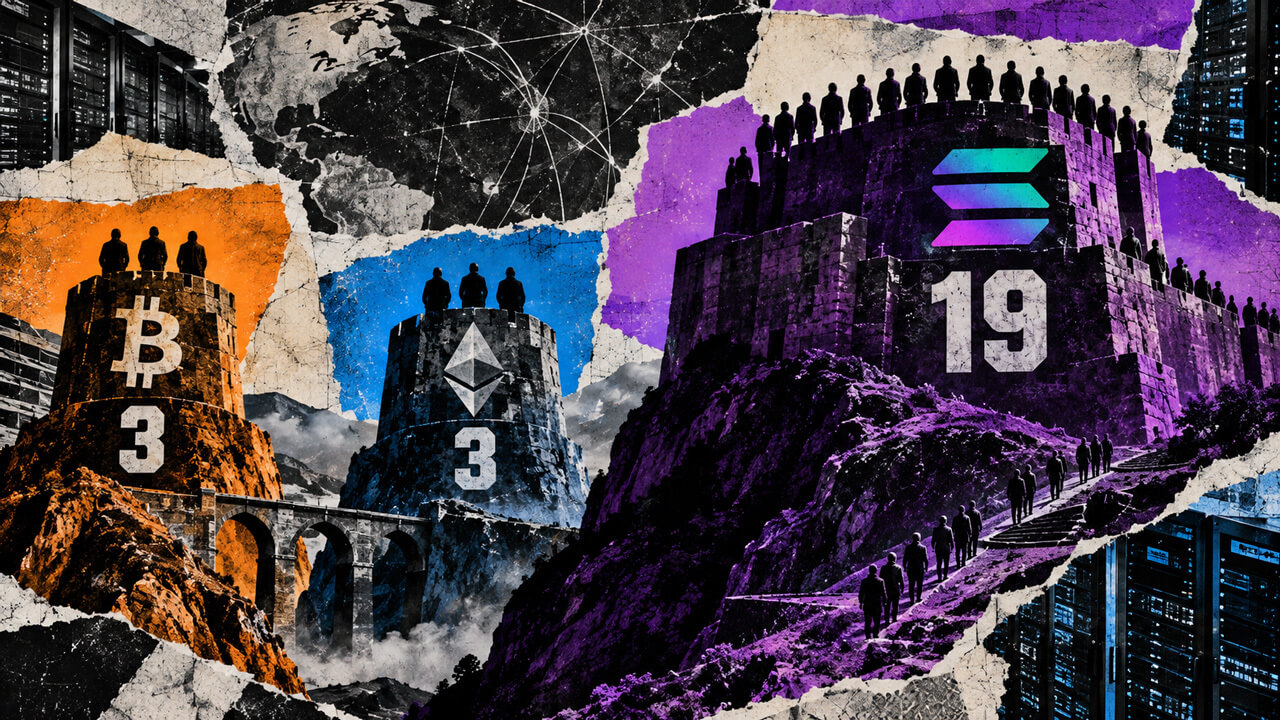
The report establishes a resilience threshold based on the number of entities needed to reach a concentration point in block production or voting power. According to the findings published on Sept. 1, this threshold is three entities for Bitcoin and Ethereum, and 19 for Solana. Despite these figures, Bitcoin holds the top position in the composite decentralization ranking due to factors including auditability, ownership dispersion, and exit fluidity.
The study highlights that coordination risk varies by network architecture. For Bitcoin, the measure focuses on mining pools, where three entities coordinated 59.04% of observed block production based on a seven-day snapshot ending Sept. 6. The report notes that while pool concentration affects short-term censorship, individual miners retain the ability to redirect hash rate quickly, with estimates suggesting a position could be exited in roughly 30 seconds.
Ethereum's risk profile is assessed through staking entities. The report identifies that protocol rules dictate different outcomes based on stake percentages, such as the ability to delay finality, censor transactions, or alter history. Data from Rated Network on Sept. 6 showed Lido, SSV, and Binance as significant entities, though the report emphasizes that labels can represent complex groups of operators. Unlike Bitcoin miners, Ethereum validators are subject to a rate-limited exit process, which can take weeks under stressed conditions.
Solana's decentralization is measured by the number of validators required to reach a one-third voting-power threshold. While the joint report cited 19 entities, other sources provide varying figures; Solana Compass reported a coefficient of 18 on Sept. 6, and the Solana Foundation's June 2025 health report recorded 20. The report notes that Solana's high-throughput requirements lead to a reliance on commercial data centers, with shared software and hosting providers creating additional dependencies.
The authors suggest that institutions evaluating blockchain infrastructure should look beyond a single metric. The report advises assessing risks related to infrastructure, such as shared cloud platforms or data centers, as well as software client diversity, which mitigates the impact of shared bugs. Ultimately, the report concludes that an institutional review must incorporate beneficial ownership, delegation sources, and the time required to exit a network to fully understand capture risk.
Stay ahead
Join our Telegram Channel
Free real-time crypto news and price alerts, the moment they break.
- Breaking News
- Price Alerts
- Market Insights