Bitcoin Price Action Diverges From Federal Reserve Financial Vulnerability Index
Bitcoin's recent market performance is driven by spot demand and liquidations, while a new Federal Reserve index highlights long-term structural risks that could amplify future market shocks.

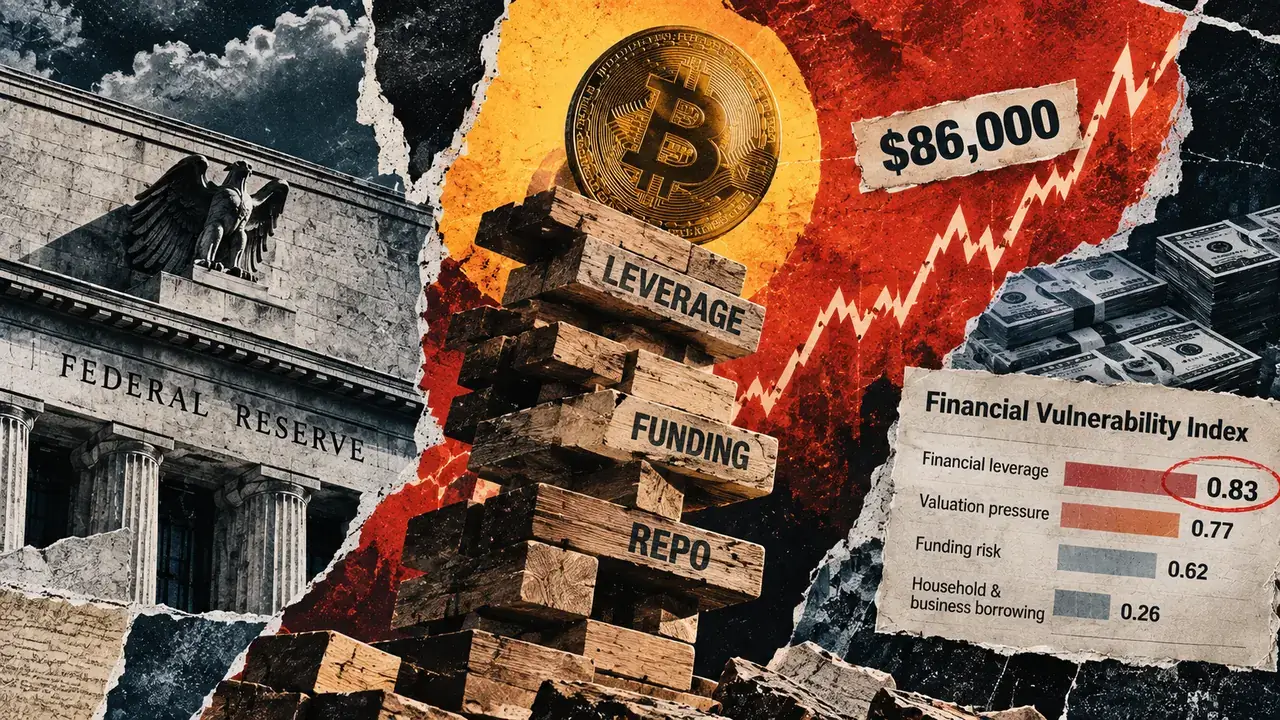
Bitcoin's recent price movement and the Federal Reserve's new Financial Vulnerability Index (FVI) are tracking different market dynamics. While BTC price action reflects immediate demand and current positioning, the FVI is designed to monitor structural weaknesses that could magnify future economic shocks.
The FVI is built to capture slow-moving vulnerabilities rather than immediate market stress. According to the index, financial leverage is currently in the elevated band of its historical distribution, while valuation pressure and funding risk are categorized as notable. Household and business borrowing levels remain lower.
Bitcoin’s recent rally saw the asset touch $86,000 on September 21, marking a move of more than 10% above the prior Sunday close. This price action was supported by positive spot taker flow, increased volume, and short liquidations. At the time, futures open interest and funding rates paid by longs were above high bands, while options open interest reached near $41 billion.
The distinction between the FVI and current market conditions is significant because conventional financial-conditions indexes typically rise only when credit tightens or visible stress emerges. In contrast, the FVI can increase during calmer periods as leverage and risk-taking accumulate. The index serves as an amplifier gauge, indicating that the system's capacity to absorb shocks is lower during high-FVI periods.
Large hedge funds held $4 trillion in gross Treasury exposure and $3 trillion in repo borrowing as of September 2025. This included approximately $830 billion in cash-futures basis trades and $305 billion in swap-spread trades. The Federal Reserve has noted that stress in government bond-backed repo markets—such as higher margin calls or tighter dealer capacity—could potentially force liquid-asset sales, which might weaken crypto spot demand and lead to the liquidation of leveraged BTC positions.
While this cross-market sequence remains a potential scenario, the cited evidence has not observed the full chain of events. The working paper reflects the authors' analysis and does not indicate concurrence by the Federal Reserve Board.